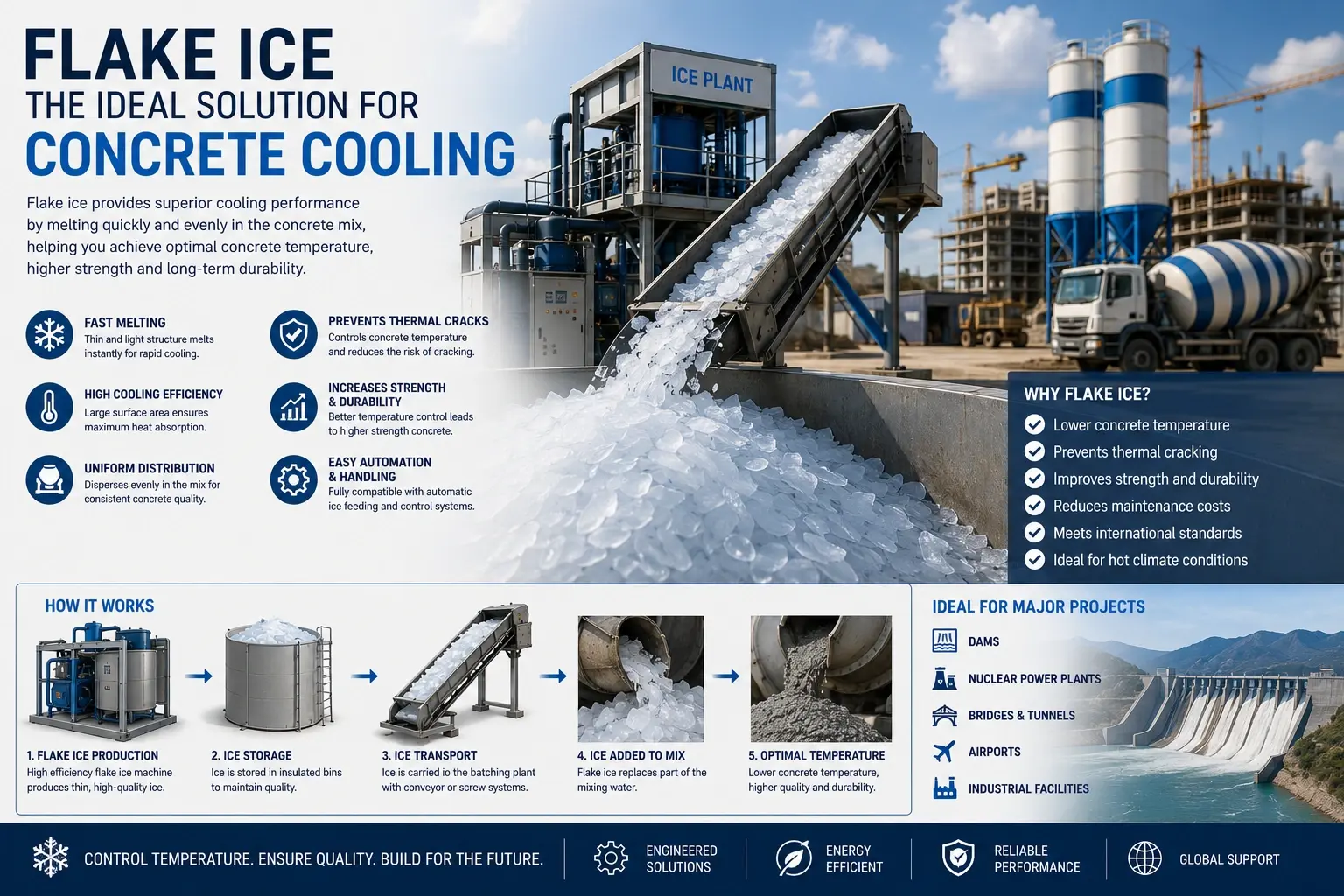
Maintaining the correct concrete temperature is one of the most critical factors in ensuring the quality, strength, and long-term durability of modern infrastructure projects. In hot climate regions, excessive ambient temperatures can significantly increase the temperature of fresh concrete, creating serious challenges during placement.
For this reason, concrete cooling systems have become an essential part of major construction projects such as dams, nuclear power plants, airports, bridges, tunnels, ports, and industrial facilities. While several cooling methods are available, flake ice has become the preferred solution worldwide due to its exceptional cooling performance and operational efficiency.
But what makes flake ice superior to other types of ice for concrete cooling applications?
Why Does Concrete Need Cooling?
Concrete generates heat during the cement hydration process. In mass concrete applications, this heat becomes trapped inside the structure, creating significant temperature differences between the core and the surface.
Without proper temperature control, this can lead to:
- Thermal cracking
- Reduced structural strength
- Lower long-term durability
- Increased maintenance costs
- Failure to meet engineering specifications
Concrete cooling helps maintain the required placement temperature, ensuring structural integrity and extending the service life of the project.
What Is Flake Ice?
Flake ice is a thin layer of ice produced on the surface of a cylindrical evaporator and typically measures between 1.5 and 2.5 mm in thickness.
Because of its thin structure and large surface area, flake ice melts almost instantly when mixed into concrete, providing rapid and efficient cooling throughout the entire mixture.
These characteristics make flake ice the ideal cooling medium for mass concrete applications.
Advantages of Flake Ice for Concrete Cooling
1. Rapid Melting Performance
One of the biggest advantages of flake ice is its large surface area.
Unlike larger ice pieces, flake ice melts almost immediately after entering the concrete mixer, absorbing a significant amount of heat during the melting process.
This enables contractors to achieve the desired concrete temperature quickly and consistently.
2. Superior Cooling Efficiency
Flake ice provides much higher cooling efficiency than block ice or tube ice.
Its advantages include:
- Faster heat transfer
- Larger contact surface
- Immediate cooling effect
- Maximum utilization of latent heat
As a result, lower concrete temperatures can be achieved with greater energy efficiency.
3. Uniform Distribution Throughout the Mix
The thin and flexible structure of flake ice allows it to disperse evenly throughout the concrete mixture.
This ensures:
- Uniform temperature distribution
- Consistent concrete quality
- Reduced temperature variations
- Improved workability
Uniform cooling is particularly important in large concrete pours where temperature consistency directly affects structural performance.
4. Improved Concrete Strength and Durability
Producing concrete at the proper temperature significantly improves its mechanical performance.
Temperature-controlled concrete offers:
- Higher compressive strength
- Reduced thermal stress
- Lower shrinkage risk
- Longer service life
- Better long-term durability
These benefits are especially valuable in infrastructure projects designed to operate for several decades.
5. Full Compatibility with Automated Concrete Plants
Modern flake ice plants can be fully integrated with:
- Automatic ice storage systems
- Screw or belt conveyor systems
- Concrete batching plants
- PLC-based automation
- Temperature monitoring systems
Automation increases production efficiency while reducing manual handling and operational errors.
6. High Production Capacity for Mega Projects
Flake ice plants are available in capacities ranging from a few tons per day to several hundred tons per day.
This makes them suitable for projects such as:
- Dams
- Nuclear power plants
- Airports
- Bridges
- Tunnels
- Metro systems
- Ports
- Hydroelectric projects
- Industrial facilities
Large-scale infrastructure developments often require continuous and reliable ice production throughout the construction period.
Flake Ice vs. Block Ice vs. Tube Ice
Although different types of ice can be used for cooling applications, flake ice clearly offers superior performance for concrete production.
| Feature | Flake Ice | Block Ice | Tube Ice |
|---|---|---|---|
| Melting Speed | Excellent | Low | Medium |
| Heat Transfer Efficiency | Excellent | Low | Medium |
| Uniform Mixing | Excellent | Poor | Moderate |
| Automatic Feeding | Yes | Limited | Yes |
| Concrete Cooling Performance | Excellent | Low | Moderate |
This comparison explains why flake ice has become the industry standard for concrete cooling worldwide.
Where Is Flake Ice Most Commonly Used?
Flake ice systems are particularly important in regions with high ambient temperatures and continuous infrastructure development.
Major markets include:
- Saudi Arabia
- United Arab Emirates
- Qatar
- Kuwait
- Oman
- Egypt
- Türkiye
- African countries
- South Asia
These regions rely heavily on concrete cooling technologies to maintain construction quality despite extreme weather conditions.
Flake ice has become the preferred cooling medium for concrete production because of its rapid melting characteristics, superior cooling efficiency, uniform distribution, and seamless integration with automated batching systems.
Compared with block ice and tube ice, flake ice delivers faster temperature reduction, better concrete quality, and greater operational efficiency. As infrastructure projects become larger and climate conditions more demanding, flake ice plants will continue to play a vital role in ensuring high-quality concrete production and long-lasting structures.
Selecting the right flake ice plant based on project capacity, environmental conditions, and required concrete temperatures is a key investment that enhances both construction quality and long-term project success.